
Operator note: screenshots in this post are redacted. Tokens, account headers, and workflow metadata are blurred. Config examples use placeholders only.






I wanted a GitHub-style contribution graph on the About page — but I also run a private Gitea forge for homelab and infrastructure work. Publishing that activity is useful. Publishing which private repositories I touched, with commit messages and branch names attached, is not.
So I split the problem into three repositories with a hard boundary:
private exporter → public artifact → public blog display
The blog never calls GitHub or Gitea APIs. It only renders committed JSON. The homelab never needs a token for umi4.life. The only cross-repo credential lives in GitHub Actions on the artifact repo.
Interesting. Version 1 was “just fetch at build time.” Version 2 was “three repos and a timer.” Version 2 is the one that stopped being rude.
The architecture
  flowchart LR
  subgraph homelab ["Proxmox LXC"]
    timer["systemd timer 15min"]
    exporter["git-activity-exporter"]
    timer --> exporter
  end

  subgraph github_public ["GitHub public"]
    artifact["Umi4Life/git-activity"]
    vendorCI["vendor-to-umi4life workflow"]
    blog["Umi4Life/umi4.life"]
    pages["GitHub Pages"]
  end

  exporter -->|"SSH push if changed"| artifact
  artifact --> vendorCI
  vendorCI -->|"commit static/data/activity.json"| blog
  blog --> pages
| Repo | Visibility | Role |
|---|---|---|
git-activity-exporter | Private Gitea | Fetch GitHub + Gitea APIs, merge counts, render SVG, push artifacts |
git-activity | Public GitHub | Sanitized data/activity.json + public/activity.svg |
umi4.life | Public GitHub | Hugo blog; heatmap shortcode reads vendored JSON |
Sensitive values stay out of all three public surfaces: no API tokens in the blog repo, no private repo slugs in the JSON contract, no commit messages in the heatmap payload.
What the blog actually renders
Each day is one ActivityDay row:
{
  "date": "2026-06-01",
  "github": 2,
  "private": 5,
  "total": 7
}
The renderer lives in the blog repo:
- Shortcode:
layouts/shortcodes/git-activity.html - Client script:
assets/js/git-activity-heatmap.js - Styles:
assets/css/git-activity-heatmap.css
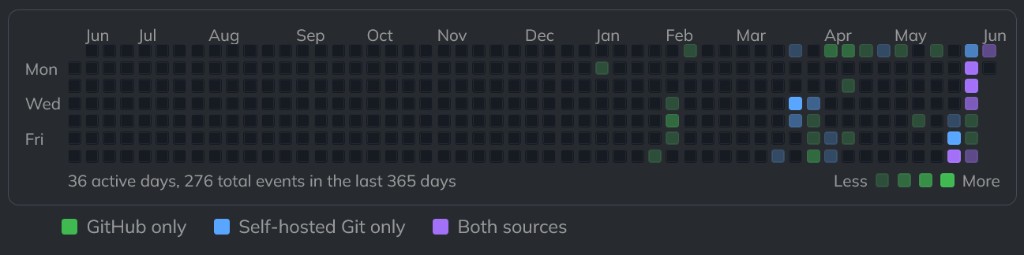
Color semantics:
- Blue — public GitHub activity only
- Green — private forge activity only
- Purple — both on the same day
The live widget on /About/ reads /data/activity.json. That file is vendored by CI from Umi4Life/git-activity. Do not edit it manually on the blog — use scripts/vendor-activity.sh for local Hugo parity.
Example embedded in this post:
This graph shows daily commit counts only. Repository names, commit messages, branch names, and file paths are intentionally omitted.
The private exporter
The exporter runs on a Proxmox LXC (exporter-lxc in my notes — hostname redacted in screenshots). It is a small Python project:
- GitHub — GraphQL
contributionsCollectionfor the public profile - Gitea — heatmap API on
https://git.umi4.life, with a repo-scan fallback if the endpoint shape changes - Merge — per-day
github,private, andtotalcounts over a 365-day window - Render — optional SVG preview in the artifact repo
.env on the homelab (placeholders only):
GITEA_BASE_URL="https://git.umi4.life"
GITEA_USERNAME="umi4life"
GITEA_TOKEN="{GITEA_READONLY_TOKEN}"
GITHUB_USERNAME="Umi4Life"
GITHUB_TOKEN="{GITHUB_PAT_READONLY}"
ACTIVITY_REPO_PATH="/srv/automation/git-activity"
WINDOW_DAYS="365"
publish_activity.sh is the entry point the systemd unit calls:
python3 scripts/run_export.py --live --sync-repo
cd "${ACTIVITY_REPO_PATH}"
git add data/activity.json public/activity.svg
git diff --staged --quiet && exit 0
git commit -m "Update sanitized git activity artifacts"
git push
Conditional push matters. Without it, a 15-minute timer would spam empty commits. With it, idle ticks log No artifact changes to publish. and exit cleanly.
No Docker. A oneshot systemd service plus timer is enough for a single Python script on an LXC. Docker would add image builds and volume wiring for no real gain here.
Homelab setup scars (real order, not idealized)
- Clone exporter to
/srv/automation/git-activity-exporter apt updatethenpython3-venv— stale package lists caused a 404 on first try- Recreate venv after
mv— moving the repo breaks venv symlinks - Use
python3, notpython— Debian Bookworm does not aliaspython - Clone
Umi4Life/git-activityto/srv/automation/git-activity - SSH deploy key with write access — HTTPS push prompted for a username; automation hosts should not do that
git config user.emailin the artifact clone — otherwise commit fails with “Author identity unknown”- systemd
Environment=PATH=.../.venv/bin:...— the service runs outside your interactive shell
The exporter LXC only needs outbound HTTPS to GitHub and Gitea plus SSH push to the public artifact repo.
CI: vending JSON into the blog
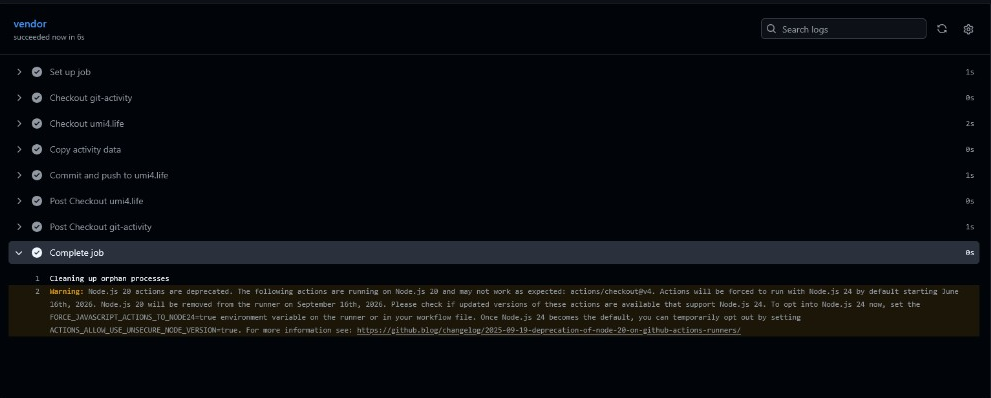
When data/activity.json changes on master, a workflow in Umi4Life/git-activity checks out both repos, copies the file to umi4life/static/data/activity.json, and pushes only if the content changed.
The first run failed exactly where it should:
actions/checkout on a sibling repository needs a PAT. The default GITHUB_TOKEN only covers the repo running the workflow.
Fix: add UMI4LIFE_REPO_TOKEN to git-activity → Settings → Secrets → Actions. I used a classic PAT with the repo scope scoped to what that token can access. Fine-grained tokens with Contents: Read and write on umi4.life only are tighter.
After the secret landed, the vendor job went green:
That commit triggers the existing Hugo deploy workflow on umi4.life. No changes to the blog’s deploy pipeline were required.
Operational loop (closed)
systemd timer (15min)
→ publish_activity.sh
  → run_export.py --live --sync-repo
  → git push git-activity (if changed)
→ git-activity vendor CI
→ umi4.life bot commit on static/data/activity.json
→ Hugo Pages deploy
→ /about/ heatmap updates
Manual one-shot on the LXC:
systemctl start git-activity-exporter.service
journalctl -u git-activity-exporter.service -n 30 --no-pager
Lessons learned
| Symptom | Cause | Fix |
|---|---|---|
python: command not found | Debian ships python3 only | Use python3; put venv on systemd PATH |
| venv broken after move | Absolute paths inside .venv | rm -rf .venv && python3 -m venv .venv |
Author identity unknown | No git config in artifact clone | Local user.name / user.email in that repo only |
Input required: token in CI | Missing UMI4LIFE_REPO_TOKEN | PAT secret on git-activity, not the blog |
| Empty commits every 15 min | Unconditional git push | git diff --staged --quiet guard |
The Node.js 20 deprecation warning on actions/checkout@v4 is GitHub housekeeping. It did not block the pipeline.
Outcomes and skills demonstrated
- Security boundary design: split private export, public artifact, and read-only blog display so tokens and metadata never cross the wrong trust line.
- Multi-forge API integration: GitHub GraphQL contributions plus Gitea heatmap API, with a repo-scan fallback when the endpoint shape shifts.
- Homelab automation: systemd oneshot + timer, conditional
git push, SSH deploy keys, and venv-aware service units on Proxmox LXC. - Cross-repo CI: GitHub Actions checkout of a sibling repository via PAT, with idempotent vendor commits.
- Frontend data contract: sanitized
ActivityDayJSON, Hugo shortcode renderer, and CI-vendored static assets for deterministic builds. - Operational writeups: redacted screenshots, placeholder secrets in examples, and engineering notes from real setup failures.
Considered and rejected: employer-hosted Git
The exporter could theoretically pull from additional Git providers, including employer-hosted Git. I considered it and decided against publishing that signal on a personal site.
  flowchart LR
  idea["More Git providers"]
  tech["Technically feasible"]
  risk["Cadence metadata risk"]
  policy["Employer data boundary"]
  optics["Professional optics"]
  reject["Excluded from public artifact"]
  idea --> tech
  tech --> risk
  risk --> reject
  policy --> reject
  optics --> reject
Daily commit counts do not expose code, repo names, messages, or paths — but they are still metadata. Metadata can reveal cadence: active days, quiet periods, crunch-like patterns. Data derived from employer systems may fall outside what belongs on a personal blog, even when aggregated. Professional optics matter too: sanitization does not fully answer “why is employer-derived activity on a personal site?”
The public artifact stays public GitHub + personal homelab Gitea only. That is a deliberate boundary, not a missing feature.
What we deliberately did not do
- Fetch at Hugo build time — the JSON is committed; builds stay deterministic and token-free
- Blog PAT on the homelab — push target is
git-activityonly; vendor CI owns the blog update - Private metadata in public JSON — no repo names, messages, or branch names in the artifact contract
- Employer-hosted Git activity — the pipeline could technically ingest more Git providers, but the public artifact intentionally excludes employer-derived metadata. Daily counts are still metadata, and metadata can reveal cadence.
Links
- Public artifact repo: github.com/Umi4Life/git-activity
- Blog repo: github.com/Umi4Life/umi4.life
- Live heatmap: About
- Local dev vendor helper:
scripts/vendor-activity.sh/scripts/vendor-activity.ps1
The exporter itself stays on private Gitea. If you self-host a similar pipeline, treat the homelab as a count exporter, the public repo as a sanitized artifact, and the blog as a read-only display layer.
Good. That is a real improvement — and the chart finally updates itself.
Leave a comment